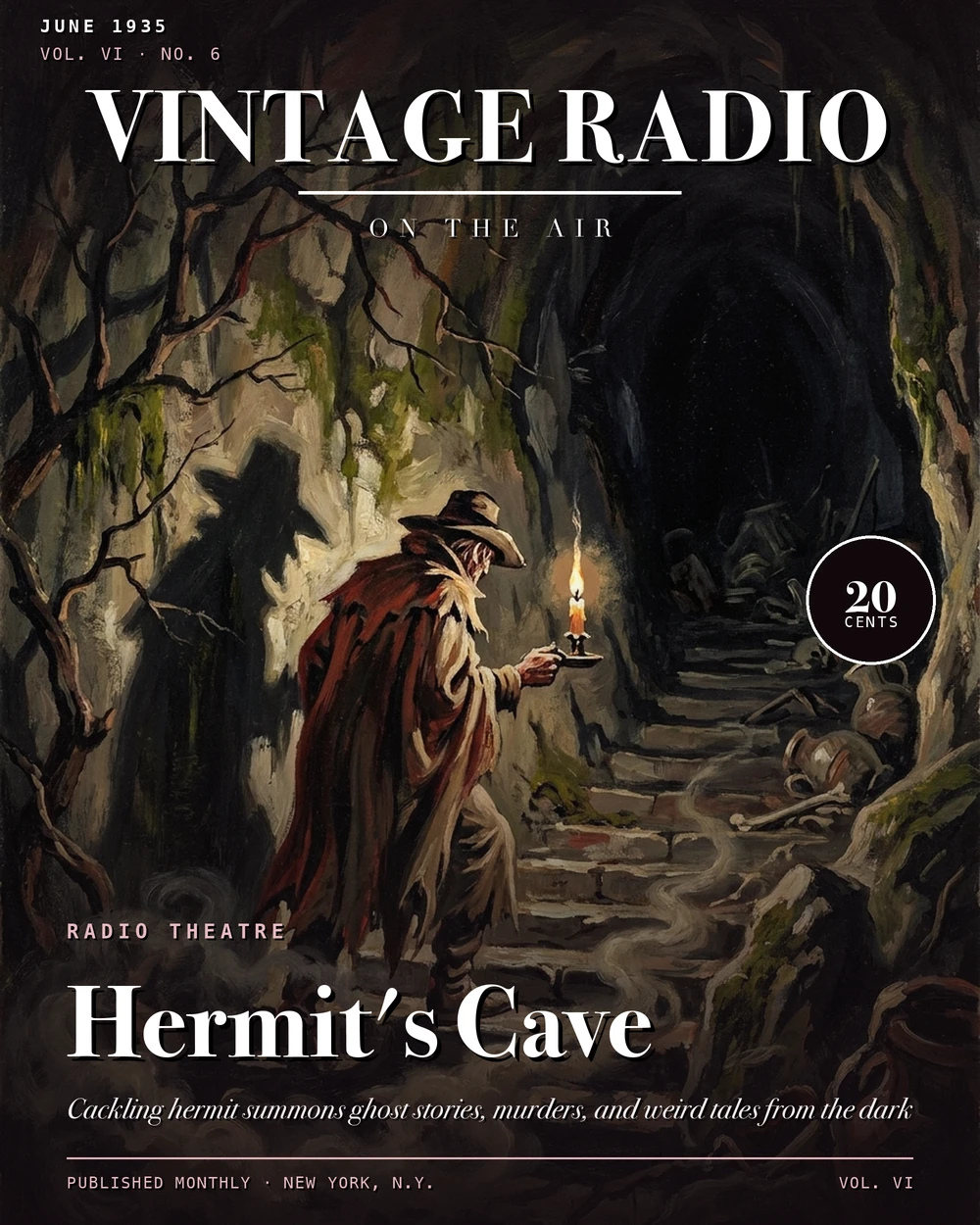
Hermit's Cave
The Voice From the Cave
The instruction was simple and impossible to ignore: turn out your lights. That was the Hermit's standing order to anyone tuning in, delivered in a raspy, echoing voice over the sound of howling wind. "Ghooooost stories! Weeeeeiiiiirrrrrddddd stories! and murders, too! The Hermit knows of them all! Turn out your lights! TURN THEM OUT!" Whatever followed that opening — and it was almost always something grim — it arrived already wrapped in dread. That atmosphere, more than any single story, is what people remembered about Hermit's Cave. The show's framework of howling winds and that raspy voice was still memorable to listeners nearly sixty years after the original broadcasts.
The show started at WJR in Detroit around 1935 and ran there until the mid-1940s. From Detroit it was syndicated to large markets across the country — interestingly, via scripts rather than transcription discs in the early years, so individual stations broadcast the program using their own local casts. Later, by 1942, WJR's broadcasts were being recorded and rebroadcast a week later on WBBM in Chicago, with eight additional cities picking up transcriptions by 1943. The Detroit version ran mostly 30-minute episodes, with some 15-minute stories in the first year. Olga Coal, a home-heating product of the Carter Coal Company, came on as the Detroit sponsor around 1937 and stayed; the Simoniz Company, whose automotive cleaner was a familiar drugstore-shelf brand, also appeared among the show's sponsors across the run. The program built a reputation for network-quality production and especially for its grisly sound effects, handled in Detroit by Sidney Erecliner and John Foster.
The Hermit Himself — and All His Voices
One of the stranger facts about Hermit's Cave is that the Hermit wasn't any one person. In Detroit, at least four different actors played the role across the run: John Kent, Charles Penman, Toby Grimmer, and Klock Ryder. The character was defined more by the performance style — cackling, rasping, intoning horror from some dark cave — than by the specific voice behind it, which says something about how strong the format was. A listener tuning in knew exactly what they were getting regardless of who was under the makeup that week.
The Detroit cast beyond the Hermit came from a group called the Mummers, a local radio acting ensemble who co-billed their work as "The Little Theater of the Air." The standard announcer tag set the frame explicitly: "The Mummers in the Little Theater of The Air present The Hermit's Cave." The Mummers included Lillian Popkin, Margery Richmond, Jack Kessler, Ted Johnstone, Jan Koste, and Bill Saunders. Actors Paul Hughes and Rollon Parker were familiar to Detroit-area listeners from their work on The Lone Ranger. The writing and producing side of the Detroit operation was handled by Eric Howlett and Geraldine Elliott, with multiple sources crediting Mr. and Mrs. Howlett as the creators when the show formally launched on WJR in September 1937.
A Franchise in Five Phases
Pinning down a single start and end date for Hermit's Cave undersells what the show actually was. Across roughly fourteen years it operated as a franchise in at least five distinct phases, each with its own title, sponsor, or city. The earliest phase ran from about 1930 to 1936: 15-minute Mummers sketches on WJR featuring a character called the Hermit. From 1936 to 1937 came an unsponsored introductory run titled "In the Hermit's Cave," roughly 19 episodes that established the format. The flagship phase followed from 1937 to 1947 — the Olga Coal–sponsored Detroit run under the final title, "The Hermit's Cave," comprising something like 539 episodes. One surviving Detroit episode closer pegs the count at "the 410th story of The Hermit made possible through the courtesy of the Carter Coal Company," which lines up with the scale of that run.
Two parallel West Coast phases sat alongside the Detroit work. From 1938 to 1939, the Don Lee–Mutual network carried a variant titled "The Devil's Scrapbook," roughly 37 episodes in which the host was Satan rather than the Hermit, voiced by Charles Penman reading horror stories out of his infernal scrapbook. Only one episode is known to survive — "The Conquest of David Rugg," featuring Noreen Gammill alongside Penman. Then from 1940 to 1944, after KMPC expanded to 24-hour programming and secured rights to its own West Coast version, the Devil's Scrapbook format was replaced by a proper KMPC production of "The Hermit's Cave," running roughly 217 episodes. The Detroit show itself returned briefly to WJR in January 1950 in a short revival after the KMPC run had ended.
The West Coast Branch
G. A. Richards owned WJR, and when he expanded into the Los Angeles station KMPC, he brought the Hermit's Cave concept west with him. The KMPC version ran from around 1940 to 1944, also in 30-minute episodes. It was its own separate production with its own cast and crew — not a rebroadcast of the Detroit material, but a parallel show built to the same formula.
Mel Johnson played the Hermit first on KMPC, taking on the ancient character at just 24 years old during what was arguably the show's peak period in 1942. After 1942, John Dehner took over the role at 28. Rex Koury handled the music, and Dwight Hauser took care of sound effects. Bill Forman produced, while Lou Huston and Herbert R. Connor wrote the stories. Character roles were filled by Elliott Lewis, Tyler McVey, William Hall, Shirley Crowell, and others.
A Training Ground for What Came Next
The KMPC version of Hermit's Cave is worth noting for a different reason beyond the horror tales themselves: the people it put to work. William Conrad was the actor-producer on the KMPC version and was only 22 years old at the time — already on his way to the radio career that would later make him the original Marshal Matt Dillon on Gunsmoke. Elliott Lewis, who played character roles on the show, wrote the very first radio script of his career for Hermit's Cave, an episode titled "The Drain"; he would go on to a career wide-ranging enough that CBS Radio Publicity eventually nicknamed him "Mr. Radio." John Dehner, who stepped into the Hermit's cave after Mel Johnson, was in his late twenties and building credits that would carry him to the title role of Paladin on the radio Have Gun — Will Travel and to over 260 film and television appearances.
KMPC functioned as a training ground for young performers with ambitions toward network work, and Hermit's Cave was one of the shows that gave them a place to develop. The work was real — the show's production values were considered comparable to what the networks were doing — and the atmosphere it demanded was unusual enough to stretch an actor's range in ways that more conventional programs didn't.
What Made It Work
Strip away the cast list and the production history, and the core of Hermit's Cave was a very old idea: a storyteller who creates a frame of dread and then hands you a frightening tale to sit inside. The Hermit wasn't a character in the stories he told. He was the keeper of them — the one who'd somehow collected every ghost story, every murder, every weird happening, and decided to share them in the dark. The howling wind was constant. The raspy voice was constant. Whatever the story changed from week to week, those two things didn't.
That format put the show near the front of a small but influential lineage, widely recognized as one of the first of the "best heard in the dark" horror shows with a spooky host. Richard J. Hand's scholarly study Terror on the Air!: Horror Radio in America, 1931–1952 situates it within the hosted-horror anthology tradition that would shape the next two decades of the genre. The model wasn't wholly original — Radiohorrorhosts.com notes it was probably inspired by the success of The Witch's Tale, with the structural twist of swapping a cackling old woman host for a cackling old man — but Hermit's Cave helped establish the convention of the wind-haunted narrator that later shows would refine.
Listeners knew the ritual before a word of the actual story was spoken. The format allowed for enormous variation in the tales themselves — ghost stories one week, murder mysteries the next, something weirder after that — while always delivering the same experience of being ushered into the cave by that cackling, wind-battered voice. The grisly sound effects the show was known for added a physical dimension, and the deliberate absence of background music left the horror exposed, with nothing softening the edges. The syndication model mattered too: because the Detroit version traveled to large markets rather than through a live network feed, the show found audiences in cities that might never have heard of WJR. That's how a regional horror program from Detroit became nationally known, and how its signature opening became something listeners could recite decades later — not because they'd read about it, but because they'd heard it, in the dark, as the wind howled through the speaker.